
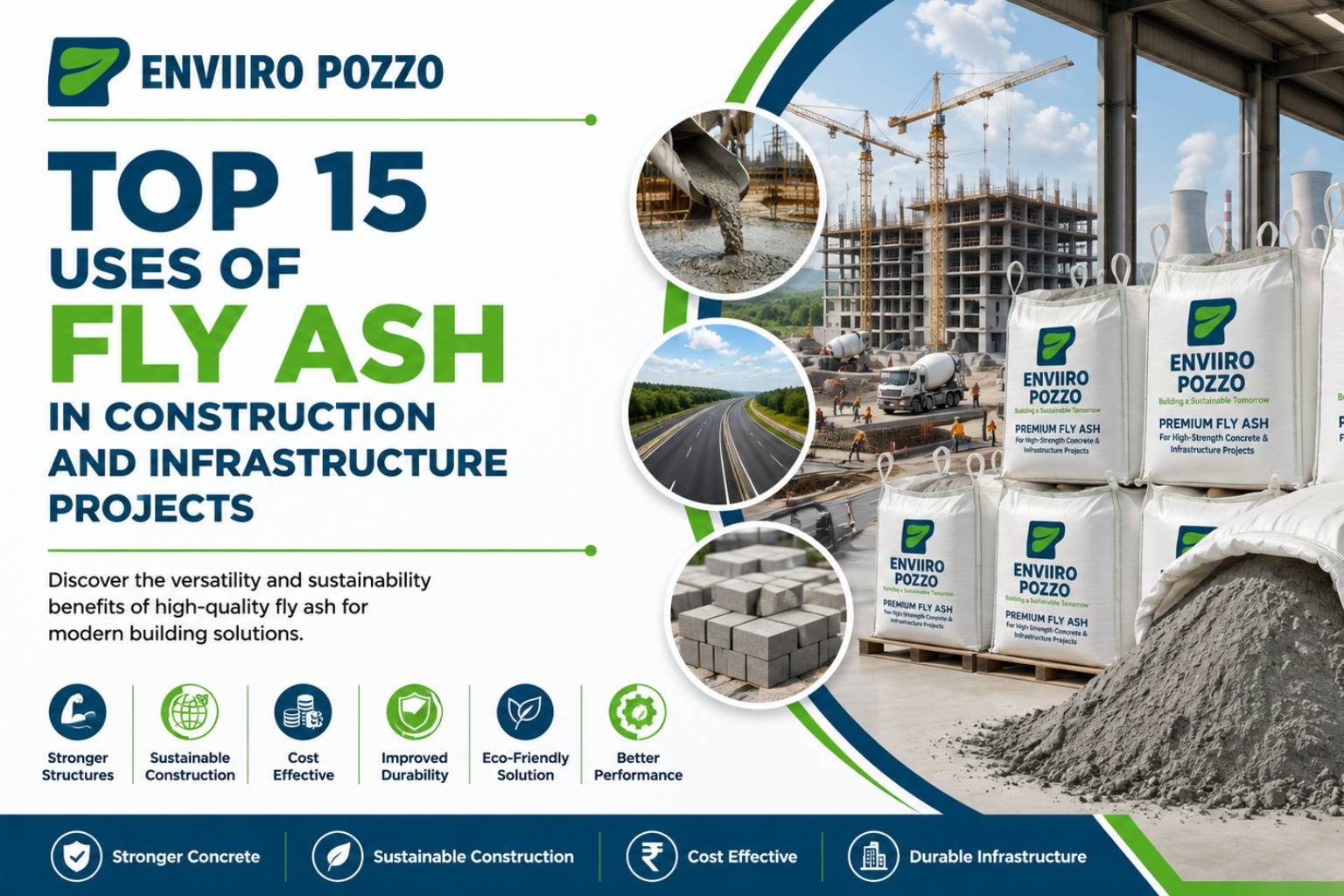
Top 15 Uses of Fly Ash in Construction and Infrastructure Projects
Fly ash, once viewed purely as an industrial waste product from coal-fired power plants, has quietly become one of the most valuable materials in modern construction. Every year, thermal power stations across the world generate massive quantities of this fine, powdery by-product — and rather than letting it pile up in ash ponds, engineers have found dozens of practical ways to put it to work. From strengthening concrete to stabilizing highways, fly ash has earned its place as a genuinely sustainable building material.
Below is a detailed look at the fifteen most important applications of fly ash in construction and infrastructure today.
1. Partial Replacement for Cement in Concrete
The single biggest use of fly ash is as a supplementary cementitious material. When blended with ordinary Portland cement, fly ash reacts with calcium hydroxide released during hydration to form additional binding compounds. This not only cuts down cement consumption but also improves the long-term strength and durability of the concrete mix.
2. Manufacturing of Fly Ash Bricks and Blocks
Fly ash bricks have become a popular alternative to traditional clay bricks. Made by combining fly ash with lime, gypsum, and sand under pressure, these bricks are lighter, more uniform in shape, and require no firing in a kiln — which also means they cut down on the deforestation and fuel consumption tied to conventional brick-making.
3. Road and Highway Sub-Base Construction
Fly ash is widely used as a fill and sub-base material in road construction. Its lightweight nature reduces the load on underlying soil, while its pozzolanic properties help it gain strength over time when mixed with lime or cement, making it ideal for embankments and pavement layers.
4. Production of Ready-Mix Concrete (RMC)
Ready-mix concrete plants routinely incorporate fly ash into their formulations to improve workability and pumpability. The spherical particle shape of fly ash acts almost like tiny ball bearings within the concrete mix, reducing water demand and making the concrete easier to place and finish.
5. Structural Fill and Embankment Material
Because of its low density compared to natural soil, fly ash is frequently used as a structural fill in embankments, particularly in areas with poor soil bearing capacity. It compacts well, drains reasonably, and helps engineers avoid the settlement problems associated with heavier fill materials.
6. Soil Stabilization Projects
In geotechnical engineering, fly ash is mixed into weak or expansive soils to improve their load-bearing capacity. This is especially useful for clayey soils that swell and shrink with moisture changes, as fly ash treatment reduces plasticity and increases stability.
7. Manufacturing of Cellular Lightweight Concrete (CLC)
Fly ash-based cellular lightweight concrete blocks are gaining traction in wall construction because of their excellent thermal insulation and reduced dead load on structures. These blocks are especially favored in high-rise buildings where reducing overall structural weight matters.
8. Grouting and Backfilling Applications
Fly ash grout is used to fill voids, abandoned mines, underground cavities, and pipeline trenches. Its flowability allows it to reach and fill irregular spaces effectively, while its low permeability once cured helps prevent water infiltration in these filled areas.
9. Production of Precast Concrete Products
Precast elements such as pipes, poles, panels, and paver blocks often include fly ash in their mix design. It contributes to a smoother surface finish, better dimensional stability, and resistance to cracking during the curing process.
10. Manufacturing of Portland Pozzolana Cement (PPC)
Fly ash is a primary raw material in producing Portland Pozzolana Cement, a widely used cement variant in many countries. PPC offers improved resistance to sulfate attack and reduced heat of hydration, making it particularly suitable for mass concreting works like dams and large foundations.
11. Use in Dam and Mass Concrete Construction
Large concrete structures like dams generate significant heat during curing due to the exothermic nature of cement hydration. Replacing a portion of cement with fly ash lowers this heat generation, reducing the risk of thermal cracking in massive concrete pours.
12. Flooring and Pavement Applications
Fly ash concrete is increasingly used for industrial flooring and pavement quality concrete (PQC) in road projects. It offers better abrasion resistance and reduced surface bleeding, resulting in a more durable wearing surface.
13. Manufacturing of Autoclaved Aerated Concrete (AAC) Blocks
AAC blocks, known for their lightweight and insulating properties, use fly ash as a core raw material along with cement, lime, and an aerating agent. These blocks have become a mainstream choice in modern construction for their speed of installation and energy efficiency.
14. Land Reclamation and Low-Lying Area Filling
Low-lying lands, mining pits, and reclaimed sites are often filled using fly ash due to its ready availability and favorable compaction characteristics. This use also serves the dual purpose of safely disposing of large volumes of ash generated by power plants.
15. Waterproofing and Concrete Durability Enhancement
Concrete containing fly ash generally exhibits reduced permeability, which translates into better resistance against chloride penetration, sulfate attack, and reinforcement corrosion. This makes fly ash a valuable addition in marine structures, bridges, and other installations exposed to harsh environmental conditions.
Why Fly Ash Matters for Sustainable Construction
Beyond its technical benefits, fly ash utilization directly supports environmental goals. Every ton of fly ash used in construction is a ton that doesn’t end up in an ash pond, reducing land use, potential groundwater contamination, and airborne dust issues. At the same time, using fly ash to replace cement reduces the carbon footprint of concrete production, since cement manufacturing is a major source of industrial CO2 emissions.
As green building codes and sustainability certifications continue to gain importance across the construction industry, fly ash is likely to remain a cornerstone material — proving that what was once considered waste can become one of construction’s most resourceful assets.
Note: Fly ash properties and permissible usage percentages can vary based on the source coal, power plant technology, and applicable regional standards. Always refer to relevant construction codes (such as ASTM C618 or IS 3812) before finalizing mix designs for specific projects.
Why Choose Enviiro Pozzo for Premium Fly Ash?
At Enviiro Pozzo, we are committed to supplying premium-quality fly ash for construction and infrastructure projects. Our fly ash is carefully sourced and quality-tested to ensure consistent performance across applications such as concrete production, cement manufacturing, road construction, soil stabilization, fly ash bricks, and precast concrete products.
Whether you’re a builder, contractor, infrastructure developer, or ready-mix concrete manufacturer, Enviiro Pozzo provides reliable fly ash solutions that help improve strength, durability, and sustainability while supporting cost-effective construction.
Why Partner with Enviiro Pozzo?
- Premium-quality fly ash
- Consistent product quality
- Reliable supply for projects of all sizes
- Suitable for concrete, cement, roads, and infrastructure
- Supports sustainable construction practices
- Trusted by builders and contractors
Conclusion
Fly ash has transformed from an industrial by-product into one of the most valuable materials in modern construction. From producing durable concrete and eco-friendly bricks to strengthening roads, stabilizing soil, and supporting sustainable infrastructure, fly ash delivers significant technical, economic, and environmental benefits.
As the construction industry continues to prioritize quality and sustainability, the use of fly ash will only continue to grow. Choosing a trusted supplier like Enviiro Pozzo ensures you receive premium-quality fly ash that helps build stronger, longer-lasting, and more sustainable structures.
Contact Us
Looking for premium-quality fly ash for your next construction or infrastructure project? Contact Enviiro Pozzo today to find the right solution for your requirements.
Follow Us
Stay connected with Enviiro Pozzo for the latest construction insights, product updates, and industry news by following us on LinkedIn.
Frequently Asked Questions (FAQs)
1. What is fly ash used for in construction?
Fly ash is used in concrete production, cement manufacturing, fly ash bricks, road construction, soil stabilization, embankments, structural fill, and infrastructure projects.
2. Why is fly ash important?
Fly ash improves concrete strength, durability, and workability while reducing cement consumption and supporting sustainable construction.
3. Is fly ash environmentally friendly?
Yes. Fly ash recycles industrial waste, reduces landfill disposal, lowers carbon emissions, and conserves natural resources.
4. Can fly ash be used in road construction?
Yes. Fly ash is widely used in road embankments, pavement sub-bases, and soil stabilization because of its strength and lightweight properties.
5. Why choose Enviiro Pozzo?
Enviiro Pozzo supplies premium-quality fly ash with consistent performance, reliable availability, and solutions tailored for modern construction and infrastructure projects.