
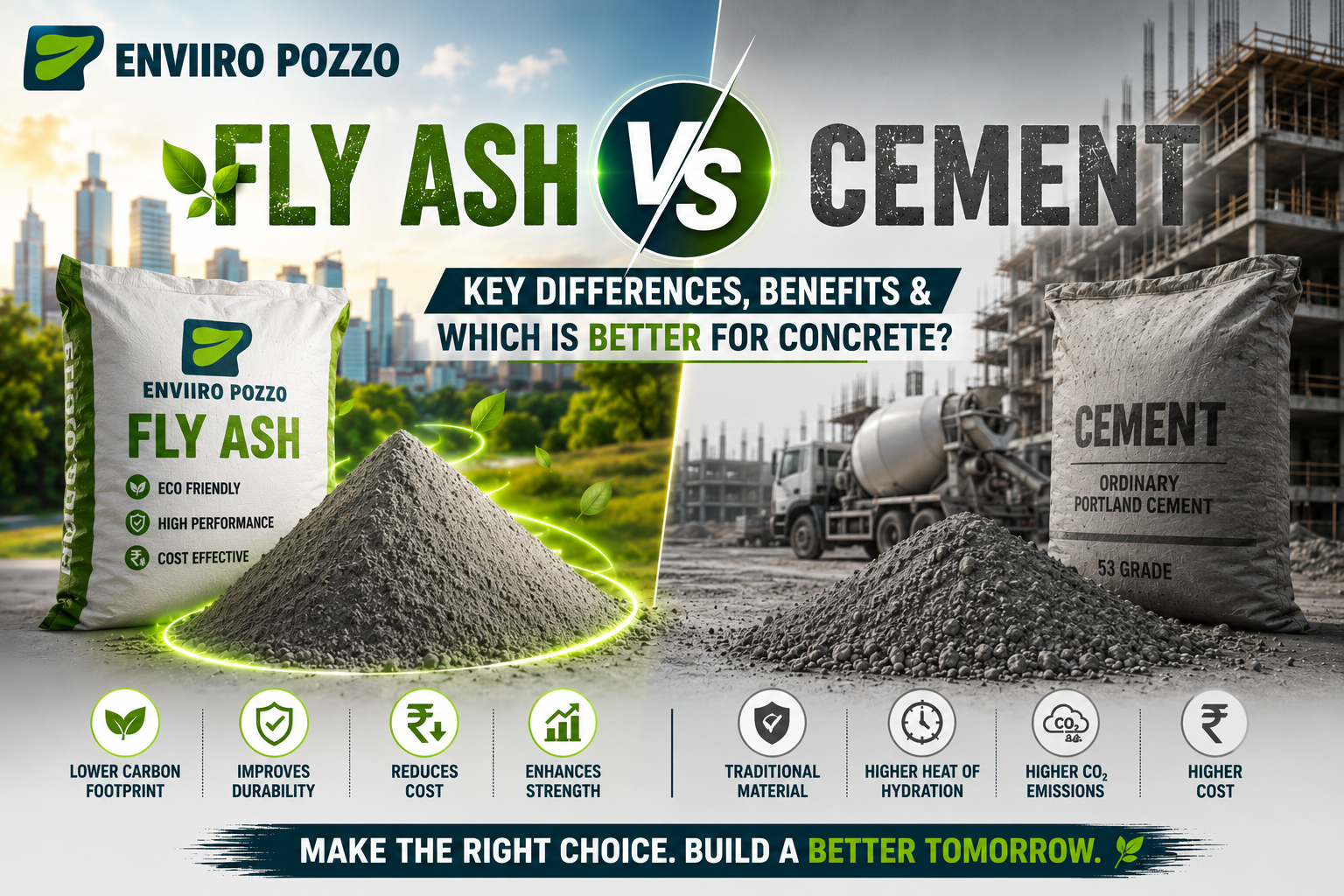
Fly Ash vs Cement: Key Differences, Benefits & Which is Better for Concrete?
Concrete is the backbone of modern infrastructure, and choosing the right construction materials plays a significant role in determining the strength, durability, and sustainability of every project. One of the most common questions among builders, contractors, engineers, and concrete manufacturers is:
Fly Ash vs Cement – Which is better?
Although these two materials are often mentioned together, they are not direct replacements for one another. Instead, fly ash and cement work together to produce stronger, longer-lasting, and more sustainable concrete.
In this comprehensive guide, we’ll compare fly ash and cement, explain their differences, highlight their advantages, and help you decide which material is best for your next construction project.
What is Cement?
Cement is a hydraulic binding material manufactured by grinding clinker with gypsum. When mixed with water, sand, and aggregates, it hardens through hydration, forming the foundation of concrete.
Ordinary Portland Cement (OPC) has been the primary binding material in construction for decades because of its excellent early strength and reliable performance.
Common Uses of Cement
- Residential buildings
- Commercial projects
- Bridges
- Roads
- Foundations
- Precast concrete
- RCC structures
What is Fly Ash?
Fly ash is a finely divided mineral powder collected during coal combustion in thermal power plants. Instead of becoming industrial waste, it is processed into a valuable supplementary cementitious material (SCM) used in modern concrete.
High-quality Classified Fly Ash, such as those supplied by Enviiro Pozzo, meets international standards including ASTM C618 Class F, making it suitable for high-performance construction and infrastructure projects.
Today, fly ash is widely used in:
- Ready Mix Concrete (RMC)
- Portland Pozzolana Cement (PPC)
- Cement manufacturing
- Fly ash bricks
- Hollow blocks
- Precast products
- High-rise buildings
- Industrial flooring
- Marine structures
Major Differences Between Fly Ash and Cement
1. Manufacturing Process
Cement requires mining, clinker production, and high-temperature kiln operations, making it energy-intensive.
Fly ash is produced as a by-product of thermal power generation and is processed into a valuable construction material instead of being discarded.
2. Strength Development
Cement develops strength rapidly during the first few days.
Fly ash develops strength more gradually but significantly improves long-term compressive strength and structural performance.
This makes fly ash ideal for projects where durability is more important than immediate strength.
3. Durability
Concrete containing classified fly ash generally performs better against:
- Sulphate attack
- Chloride penetration
- Water permeability
- Alkali-silica reaction
- Chemical exposure
These properties increase the lifespan of structures significantly.
4. Heat of Hydration
Mass concrete generates heat while curing.
Too much heat causes thermal cracks.
Fly ash reduces the heat of hydration, making it suitable for:
- Dams
- Foundation
- Rafts
- Large Concrete pours
- Infrastructure projects
5. Workability
One of the biggest advantages of fly ash is improved workability.
Its fine spherical particles create a “ball-bearing” effect inside the concrete mix, allowing:
- Better pumping
- Easier
- Improved surface quality
- Reduced water damage
6. Environmental Impact
Producing Portland cement releases a significant amount of carbon dioxide.
Using fly ash as a partial cement replacement helps:
- Reduce CO₂ emissions
- Recycle industrial by-products
- Lower landfill waste
- Support green building practices
- Improve sustainable construction
Benefits of Using Fly Ash in Concrete
High-quality classified fly ash offers several performance advantages:
- Higher long-term compressive strength
- Improved durability
- Better resistance to chemicals
- Lower permeability
- Reduced shrinkage cracks
- Better surface finish
- Increased workability
- Lower heat Generation
- Reduced cement consumption
- Lower Construction work
- Longer Service life
- Environmentally friendly construction
These benefits make fly ash one of the most preferred supplementary cementitious materials in modern construction.
Does Fly Ash Replace Cement Completely?
No.
Fly ash is not intended to replace cement entirely in conventional concrete.
Instead, it replaces a portion of cement depending on the project requirements.
Typical replacement percentages include:
- 15–25% for residential construction
- 20–35% for commercial buildings
- 25–40% for infrastructure
- Higher percentages for specialized applications with proper mix design
The exact replacement depends on structural requirements, curing conditions, and engineering specifications.
Which is Better for Concrete?
The answer depends on your objective.
Choose Cement When:
- Early strength is critical
- Fast construction is required
- Cold weather concreting
- Small residential repairs
Choose Fly Ash When:
- Long-term durability matters
- Large infrastructure projects
- High-performance concrete
- Mass concrete
- Marine structures
- Ready Mix Concrete plants
- Sustainable construction
- Cost optimization
In practice, the best concrete combines both cement and high-quality classified fly ash to achieve an ideal balance of strength, durability, and economy.
Why Builders Prefer Classified Fly Ash Today
Construction companies increasingly prefer classified fly ash because it provides:
- Consistent particle size
- Improved concrete quality
- Better compressive strength
- Reliable performance
- Compliance with ASTM C618 standards
- Lower carbon footprint
- Reduced cement consumption
As infrastructure projects continue to grow worldwide, classified fly ash has become an essential ingredient in producing durable, sustainable, and cost-effective concrete.
Why Choose Enviiro Pozzo?
At Enviiro Pozzo, we supply premium Classified Fly Ash manufactured under strict quality standards for domestic and international markets.
Our products are suitable for:
- Ready Mix Concrete
- Cement Manufacturing
- Portland Pozzolana Cement
- Fly Ash Bricks
- Hollow Blocks
- Infrastructure Projects
- Industrial Construction
- Export Applications
Our fly ash complies with international quality requirements, ensuring consistent performance across every application.
Conclusion
The comparison between Fly Ash vs Cement is not about choosing one over the other—it is about using each material where it performs best.
Cement provides the essential binding strength required for concrete, while fly ash enhances durability, improves workability, reduces environmental impact, and lowers overall project costs. Together, they create high-performance concrete that meets the demands of modern construction.
For builders, contractors, and manufacturers looking for premium classified fly ash, Enviiro Pozzo delivers reliable, high-quality solutions that support stronger, greener, and more cost-effective construction projects.