
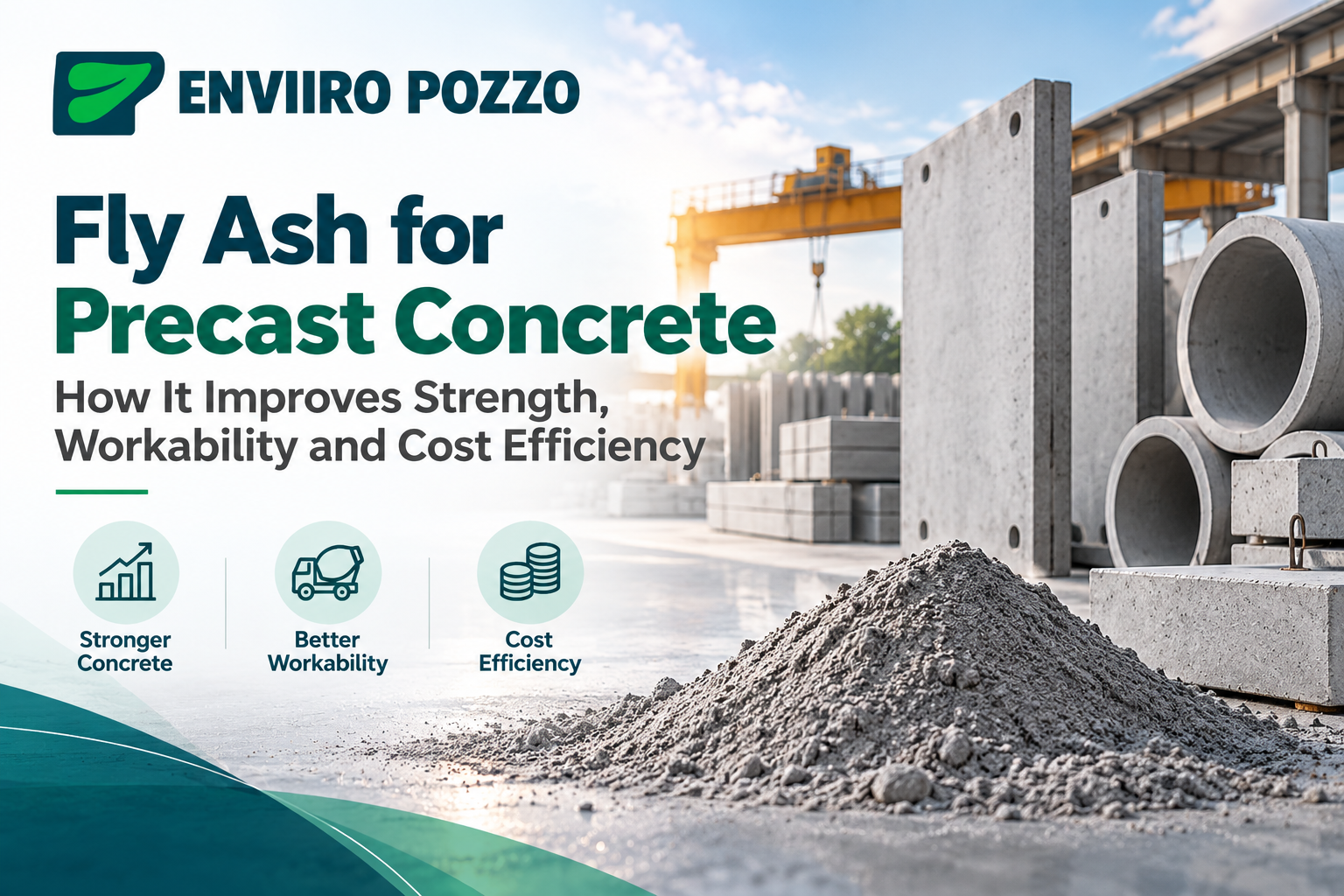
Fly Ash for Precast Concrete: How It Improves Strength, Workability and Cost Efficiency
Precast concrete needs steady material quality. It also needs controlled production and smart use of resources. Pipes, paving blocks, wall panels and structural parts all depend on strong, durable mixes.
This is where fly ash helps. It is a useful supplementary cementitious material for precast production.
In addition, a reliable fly ash supplier for precast work keeps quality steady from batch to batch.
What Is Fly Ash in Precast Concrete?
Fly ash is a fine powder. It is collected at coal-based power stations while electricity is made. It contains silica and alumina, and these react in concrete in a helpful way.
Its tiny particles can improve concrete performance. However, the mix proportions, curing method and quality control must be right.
How Does Fly Ash Improve Precast Concrete Strength?
1. Builds Long-Term Strength
When cement hydrates, it makes calcium hydroxide. Fly ash then reacts with this compound. As a result, extra calcium silicate hydrate (C-S-H) forms, and it adds strength.
Some fly ash mixes gain strength slowly at first. However, a well-designed mix reaches higher strength later.
2. Makes Concrete Denser
Fly ash particles are very fine. Therefore, they fill the small gaps between cement and aggregate.
A denser concrete lasts longer. This matters most when precast parts face moisture and harsh weather.
3. Keeps Quality Steady
Steady fly ash gives steady concrete. For this reason, manufacturers can predict strength more easily.
Consistent deliveries also make production smoother.
How Fly Ash Improves Concrete Workability
1. Improves Mix Flow and Handling
Many fly ash particles are smooth and round. Because of this, they reduce friction in fresh concrete.
The mix flows better, so it is easier to place in moulds. This helps most with detailed shapes or closely spaced reinforcement.
2. Helps Control Water Demand
Suitable fly ash improves workability without extra water. This matters because too much water weakens concrete. It can also raise permeability and affect size stability.
So, keep the water-to-binder ratio right.
3. Supports Better Surface Finishing
A well-proportioned mix is more cohesive. As a result, precast parts can have smoother surfaces and a more even look.
Still, proper compaction and curing are needed to prevent surface defects.
How Fly Ash Helps Reduce Costs in Precast Concrete Production
1. Reduces Cement Consumption
Cement is a major material cost. Replacing some cement with suitable fly ash may lower binder costs, and performance can stay the same.
However, the savings depend on the replacement level, local prices, transport charges and production needs.
2. Helps Improve Production Efficiency
Better workability makes placing and compacting easier. In some cases, this means fewer handling problems and more even mould filling.
However, check early-age strength needs first. Otherwise, demoulding and production cycles may be delayed.
3. Supports Resource-Efficient Manufacturing
Fly ash can replace part of the Portland cement in a mix. This saves resources.
It may also lower the embodied carbon linked to cement use.
Choosing the Right Fly Ash Supplier for Precast Applications
Not all fly ash performs the same way. Fineness, chemical composition, loss on ignition and particle shape can all change how concrete behaves.
So, when choosing a fly ash supplier for precast, look at these points:
- Consistent quality: Uniform material from every delivery.
- Storage and handling: Proper steps to keep moisture out.
- Technical suitability: A good match for your concrete mix and curing process.
Enviiro Pozzo: Supporting Precast Concrete Manufacturing
Enviiro Pozzo supplies fly ash for concrete and industrial use. It supports manufacturers with their sourcing needs.
For precast producers, dependable supply matters. Consistent material also protects production quality.
In short, the right fly ash and good mix design lead to stronger, more workable and cost-efficient products.
Frequently Asked Questions (FAQs)
1. Is fly ash suitable for precast concrete?
Yes. Suitable fly ash works in many precast applications. However, the mix must meet strength, durability and production specifications.
2. Does fly ash increase concrete strength?
It can improve long-term strength through pozzolanic reactions. However, early strength depends on the material, replacement level and curing conditions.
3. Can fly ash reduce precast manufacturing costs?
Yes, it can help. Replacing part of the cement with fly ash may control costs. Still, actual savings vary with material prices, delivery costs, curing methods and manufacturing processes.
4. How much fly ash should be added to precast concrete?
It depends on product needs, cement properties, fly ash quality and curing conditions. Therefore, run trial mixes in a controlled laboratory. These trials show the best proportion for your products.
5. Why is choosing a reliable fly ash supplier for precast important?
A reliable supplier keeps material quality steady. In addition, deliveries stay dependable. As a result, concrete performance is easier to predict across batches.
Conclusion
Fly ash offers real advantages for precast manufacturing. For example, it improves workability, may add long-term strength and helps cut costs.
Therefore, partner with a dependable fly ash supplier for precast work, such as Enviiro Pozzo. This secures reliable sourcing, and it supports efficient, sustainable concrete production.