
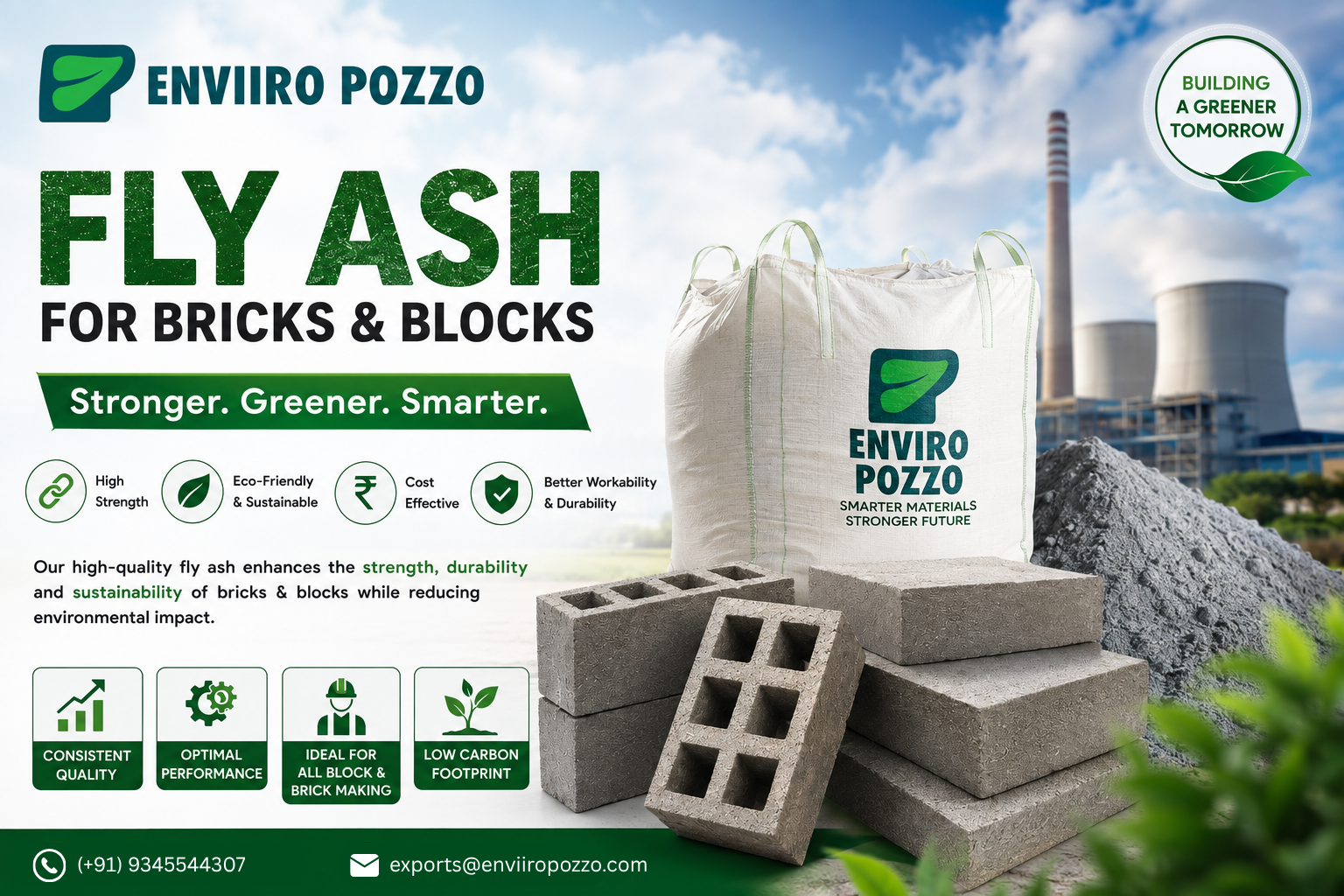
Fly Ash for Bricks & Blocks: Benefits for Manufacturers
Brick and block manufacturers are constantly evaluating ways to improve raw-material usage, production consistency, product performance, and procurement reliability. Fly ash for bricks and blocks can support these objectives when it is selected according to the application and incorporated into a properly controlled manufacturing process.
However, not all fly ash has the same characteristics. Fineness, moisture, chemical composition, unburnt carbon, batch consistency, and supply reliability can all influence manufacturing results. For this reason, manufacturers should work with a quality-focused fly ash supplier that understands bulk industrial requirements.
Quick Answer
Suitable fly ash can be used as a mineral or cementitious component in brick and block manufacturing. Depending on the formulation and production process, it may help optimize raw-material usage, support manufacturing consistency, contribute to strength development, and provide a productive use for an industrial by-product. The actual performance depends on fly ash quality, mix design, water content, compaction, curing, and production conditions.
Why Is Fly Ash Used in Bricks and Blocks?
Fly ash is a fine mineral material generated during the combustion of coal. Suitable fly ash can exhibit pozzolanic properties, allowing it to react with calcium hydroxide in the presence of moisture and contribute to cementitious compounds.
In brick and block manufacturing, fly ash may be used as part of a cementitious formulation or as a mineral component in a product mix. Its fine particle characteristics can influence packing, workability, water demand, surface finish, and final performance.
The results depend on more than the fly ash alone. Manufacturers should consider:
- Fly ash characteristics and grade.
- Cement or binder content.
- Aggregates and other raw materials.
- Water content and admixtures, where applicable.
- Compaction pressure.
- Curing conditions.
- Mixing and production equipment.
- Target strength and product dimensions.
A mix that works for fly ash cement bricks may not produce the same results in concrete blocks, pavers, roofing sheets, or other building materials. Application suitability should therefore be confirmed through technical discussion and production trials.
Key Benefits of Fly Ash for Brick and Block Manufacturers
1. Helps Optimize Raw Material Usage
Using suitable fly ash in a properly designed formulation may help manufacturers optimize the use of cement and other raw materials. This can be particularly relevant for high-volume production, where small changes in material consumption can affect overall operating economics.
The financial outcome depends on local cement prices, transportation costs, production scale, mix design, fly ash grade, and the required product performance. Fly ash should not be evaluated only by its purchase price.
A consistent material that supports stable production may be more economical than a cheaper material that causes frequent formulation adjustments.
2. Supports Consistent Manufacturing
Production consistency is essential for brick and block manufacturers supplying contractors, builders, distributors, and infrastructure projects.
Variations in fineness, moisture, particle characteristics, chemical composition, or loss on ignition can affect water demand, workability, compaction, curing, and product quality.
Classified fly ash with controlled particle characteristics can make formulation and process control easier when manufacturing conditions are properly managed.
Enviiro Pozzo's processing approach is designed to address variations in particle size, moisture, and unburnt carbon in unprocessed fly ash. The company's product information identifies controlled particle size and low loss on ignition as important product-quality objectives.
3. Can Support Strength Development
Suitable fly ash can contribute to strength development through pozzolanic reactions. In the presence of moisture, reactive components may interact with calcium hydroxide and form additional cementitious compounds over time.
This does not mean that adding fly ash automatically increases strength. Final compressive strength depends on the complete mix design, cement content, aggregate quality, water ratio, compaction, curing duration, raw materials, and manufacturing process.
Manufacturers should validate the formulation against their target strength and applicable product standards before moving to regular procurement.
4. Supports Sustainable Construction
Fly ash-based bricks and blocks provide a productive use for an industrial by-product and can support more resource-efficient construction-material manufacturing.
This can be relevant for manufacturers responding to demand for building products that use mineral resources responsibly.
Sustainability benefits should be evaluated realistically. Transportation distance, energy consumption, cement usage, processing requirements, and the complete product lifecycle all matter. A well-managed fly ash application can contribute to resource optimization without relying on exaggerated environmental claims.
5. Suitable for Large-Scale Manufacturing Requirements
A dependable bulk supply is important when a brick or block plant operates on regular production schedules. Interruptions in raw-material availability can affect dispatch commitments, labour planning, inventory levels, and customer relationships.
Manufacturers should assess whether a fly ash supplier can support:
- Recurring bulk requirements.
- Planned delivery schedules.
- Batch-to-batch consistency.
- Appropriate packaging or transport arrangements.
- Testing and quality documentation.
- Communication during procurement and delivery.
Enviiro Pozzo describes its classified fly ash as serving construction and industrial applications, with supply capability for customers across several international markets.
What Should Manufacturers Check Before Buying Fly Ash?
Before selecting a bulk fly ash manufacturer or supplier, manufacturers should evaluate both material quality and supply reliability.
Grade, fineness, particle-size characteristics and chemical composition.
Moisture level, loss on ignition and unburnt carbon characteristics.
Consistency between different production and supply batches.
Available test reports and quality documentation for the specific grade.
Performance in the manufacturer's existing formulation and process.
Monthly capacity, lead time, transportation and delivery arrangements.
The cheapest fly ash is not necessarily the most economical option. Inconsistent material may increase cement adjustment, rejected products, testing requirements, downtime, and production variability.
Why Choose a Fly Ash Manufacturer Instead of an Unverified Supplier?
A manufacturer-backed supply relationship can provide better visibility into processing, classification, product characteristics, and quality-control practices.
It may also support more consistent communication when a customer needs recurring quantities or application-specific guidance.
Enviiro Pozzo states that its fly ash is processed through beneficiation and classification at an ISO 9001:2015-certified processing unit operated by Gringotts Mines (India) Pvt Ltd. The company also identifies ASTM C618 Class F compliance for its R-34 product.
Product specifications, certifications and compliance should always be verified against the current documentation for the specific grade being purchased.
Why Choose Enviiro Pozzo for Fly Ash?
Enviiro Pozzo supplies classified fly ash for construction and industrial applications, including cement, concrete, roofing sheets, cement bricks, and blocks.
Its R-34 product information specifically lists cement bricks and blocks manufacturing among its applications and describes the material as medium-grade classified fly ash for cement and construction uses.
For brick and block manufacturers, the important question is not simply whether fly ash is available. The material should be matched to the product, mix design, manufacturing process, required quantity, and delivery schedule.
Enviiro Pozzo can be approached to discuss application suitability, samples, pricing, technical information, and recurring bulk requirements.
How to Select the Right Fly Ash for Your Process
Before finalizing procurement, share the following information with the fly ash manufacturer:
- Product type, such as bricks, blocks, pavers, or precast products.
- Current mix design and binder content.
- Target compressive strength.
- Production method and curing process.
- Required monthly quantity.
- Delivery location and preferred schedule.
- Desired fineness or other material characteristics.
Testing a representative sample in the actual production process is recommended before committing to long-term supply.
Trial results should be reviewed for workability, compaction, demoulding, surface finish, curing behaviour, dimensional stability, and compressive strength.
Frequently Asked Questions About Fly Ash for Bricks and Blocks
What is fly ash used for in brick manufacturing?
Fly ash can be used as a mineral or cementitious component in brick formulations. Suitable material may help optimize raw-material usage and support product consistency. Results depend on the mix design, binder content, moisture, compaction, curing, and quality of the selected fly ash.
Is fly ash suitable for concrete blocks?
Fly ash can be suitable for concrete block manufacturing when its characteristics match the formulation and production process. Manufacturers should evaluate fineness, moisture, chemical composition, loss on ignition, workability, compaction, curing, and final compressive strength through controlled trials.
How does fly ash benefit brick manufacturers?
Fly ash may help manufacturers optimize raw-material consumption, support consistent production, and contribute to strength development when used in a suitable formulation. It can also support resource-efficient construction products.
The actual benefit depends on local costs, mix design, process control, curing, and material consistency.
What should manufacturers check when buying fly ash?
Manufacturers should check the grade, fineness, particle-size characteristics, moisture, chemical composition, loss on ignition, batch consistency, test documentation, application suitability, bulk availability, transport arrangements, and supplier reliability before placing recurring orders.
How can I buy fly ash in bulk from a manufacturer?
Contact the supplier with your product type, target strength, current formulation, monthly quantity, delivery location, and required delivery schedule. Ask for product documentation and a representative sample, then conduct production trials before approving regular bulk procurement.
Looking for Reliable Fly Ash for Bricks or Blocks?
Contact Enviiro Pozzo to discuss your application, required fly ash grade, sample requirements, monthly quantity, and bulk supply schedule.
Explore Fly Ash SolutionsRelated topics: fly ash for bricks, fly ash for blocks, fly ash for brick manufacturing, fly ash for concrete blocks, classified fly ash, fly ash manufacturer, fly ash supplier, cement bricks, fly ash bricks, construction fly ash, bulk fly ash supply